Circle Theorems — Angles, Arcs & Chords for Junior Cycle Maths
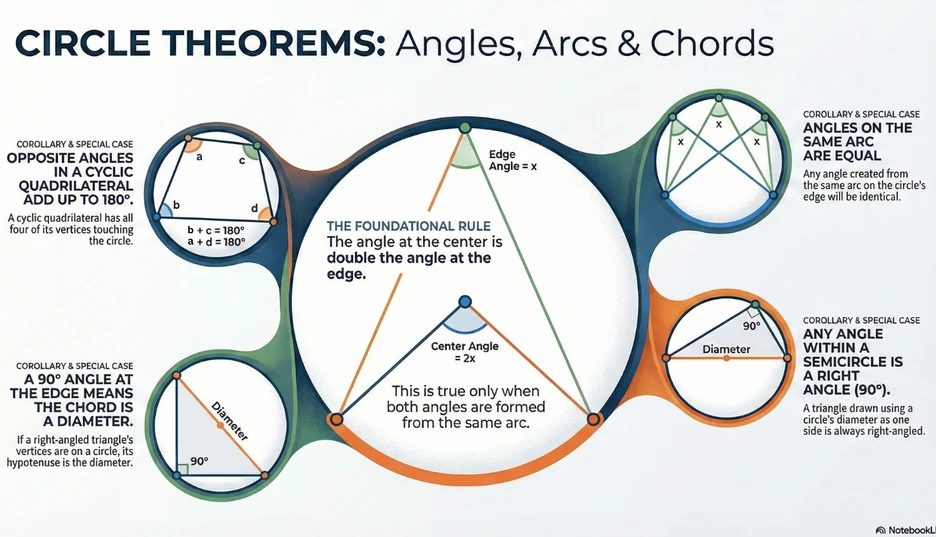
Circle theorems all flow from one foundational rule. Once you understand that rule, the four corollaries are just special cases of it. This post breaks down each one with plain-English explanations and the exam mistakes to avoid.
The Foundational Rule
The angle at the centre is double the angle at the edge (circumference), when both are standing on the same arc.
This is Theorem 19 from the course. A “centre angle” has its vertex at the centre of the circle. An “edge angle” has its vertex on the circumference. If both angles are formed from the same arc, the centre angle is always exactly twice the edge angle.
Example: If the angle at the centre is 120°, the angle at the circumference on the same arc is 60°.
Watch out! Both angles must stand on the same arc for this rule to apply. If they’re on different arcs, the relationship doesn’t hold.
Corollary 1 — Opposite Angles in a Cyclic Quadrilateral Add Up to 180°
A cyclic quadrilateral is a four-sided shape where all four vertices lie on a circle. In any cyclic quadrilateral, each pair of opposite angles adds up to 180°.
Why it follows from the foundational rule: Each pair of opposite angles stands on arcs that together make the full circle (360°). The centre angles for these arcs add to 360°, and each edge angle is half its centre angle — so the two opposite edge angles add to half of 360°, which is 180°.
Example: If one angle of a cyclic quadrilateral is 70°, the angle directly opposite it is 110°.
Exam tip: The key word is “cyclic” — all four corners must be on the circle. If even one vertex is not on the circumference, this rule doesn’t apply. Check the diagram carefully before using this corollary.
Corollary 2 — Angles on the Same Arc Are Equal
All angles at the circumference that stand on the same arc are equal.
Why it follows from the foundational rule: Each of these edge angles is half the same centre angle. Since they’re all half the same value, they must all be equal to each other.
Example: If three points on the circumference all form angles looking down at the same chord, those three angles are identical — regardless of where on the circumference the vertices sit.
Exam tip: Look for multiple triangles sharing the same base chord. The angles at the top of each triangle (on the circumference, same side of the chord) are all equal. This is one of the most commonly examined corollaries.
Corollary 3 — A 90° Angle at the Edge Means the Chord Is a Diameter
If an angle at the circumference is 90°, then the chord it stands on must be a diameter of the circle.
Why it follows from the foundational rule: If the edge angle is 90°, the centre angle must be 2 × 90° = 180°. A 180° angle at the centre means the chord passes straight through the centre — which is the definition of a diameter.
Exam tip: This is the converse of Corollary 4. Use it to prove that a chord is a diameter: if you can show the angle in the semicircle is 90°, the chord must pass through the centre.
Corollary 4 — Any Angle in a Semicircle Is 90°
Any angle at the circumference that stands on a diameter is a right angle (90°).
Why it follows from the foundational rule: A diameter creates a centre angle of 180° (a straight line through the centre). The edge angle is half of that: 180° ÷ 2 = 90°.
Example: If AB is a diameter and C is any point on the circumference (not on AB), then angle ACB = 90°. It doesn’t matter where on the circle C is — the angle is always 90°.
Exam tip: This is probably the most useful circle corollary. Whenever you see a triangle inside a circle with one side as the diameter, the angle opposite that side is 90°. This often unlocks Pythagoras or trigonometry in the same question.
How They All Connect
All four corollaries are consequences of the same foundational rule:
| Corollary | What it says | Why |
|---|---|---|
| 1 | Opposite angles in a cyclic quad sum to 180° | Opposite arcs make a full circle → half of 360° = 180° |
| 2 | Angles on the same arc are equal | They’re all half the same centre angle |
| 3 | 90° at the edge → chord is a diameter | 2 × 90° = 180° → straight line through centre |
| 4 | Angle in a semicircle = 90° | Diameter = 180° at centre → half is 90° |
If you understand the foundational rule, you can derive any of these in the exam rather than relying on pure memorisation.
Practice Questions
- A cyclic quadrilateral has angles of 85°, 95°, and 100°. Find the fourth angle.
- Two angles at the circumference stand on the same arc. One is 35°. What is the other?
- A triangle is drawn inside a circle with one side as the diameter. The two shorter sides are 6 cm and 8 cm. Find the diameter.
- An angle at the circumference is 90°. What can you conclude about the chord it stands on?
This post is based on an AI-generated infographic from Boomanotes — turn any study notes into visual revision aids.