Coordinate Geometry — A Problem-Solving Guide for Junior Cycle Maths
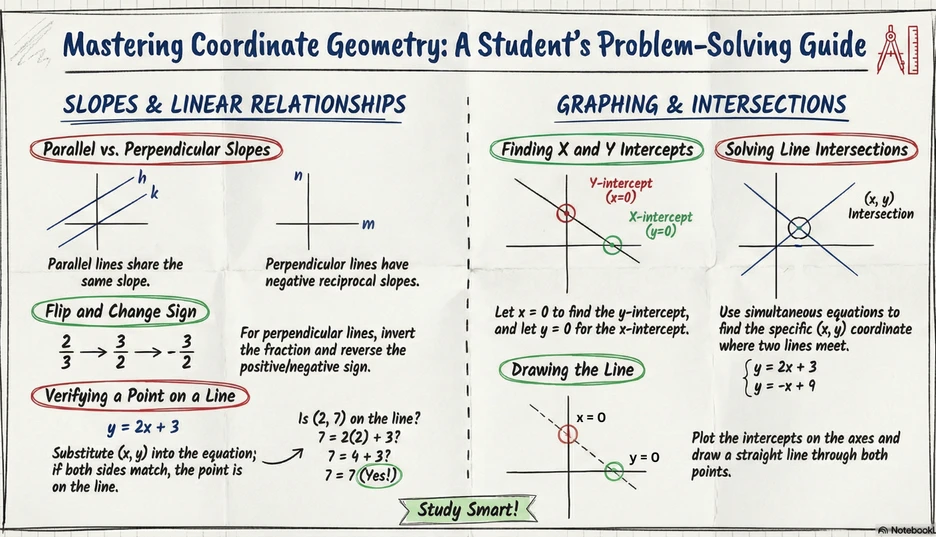
Coordinate geometry connects algebra and geometry on the coordinate plane. Once you understand a few core ideas — slopes, intercepts, and how lines relate to each other — you can tackle almost any question in this topic. This post walks through each concept with worked examples and the mistakes to avoid.
Slopes & Linear Relationships
Parallel Lines
Parallel lines have the same slope. If you know two lines are parallel, their slopes are equal.
Example: Line A has slope 2/3. Any line parallel to A also has slope 2/3.
Watch out! Same slope doesn’t mean same line — parallel lines have different y-intercepts. If both the slope and the y-intercept match, they’re the same line, not parallel lines.
Perpendicular Lines
Perpendicular lines meet at right angles (90°). Their slopes are negative reciprocals of each other.
The rule: flip the fraction and change the sign.
Example: If one line has slope 2/3, the perpendicular slope is −3/2.
Example: If one line has slope −4 (i.e. −4/1), the perpendicular slope is 1/4.
Watch out! You must do both steps — flip and change sign. Forgetting either one gives the wrong answer. Also remember: a horizontal line (slope 0) is perpendicular to a vertical line (undefined slope).
Finding a Line Using a Perpendicular Slope
This is a common exam question: you’re given a line and a point, and asked to find the equation of the line perpendicular to it that passes through that point.
Worked example: Find the equation of the line perpendicular to y = 2x + 1 that passes through the point (4, 5).
Step 1 — Find the slope of the given line. The slope of y = 2x + 1 is 2.
Step 2 — Find the perpendicular slope. Flip and change sign: 2 → −1/2.
Step 3 — Use the point-slope form with the new slope and the given point. The point-slope form is: y − y₁ = m(x − x₁)
Substituting m = −1/2 and (x₁, y₁) = (4, 5):
y − 5 = −1/2(x − 4)
y − 5 = −1/2 x + 2
y = −1/2 x + 7
Watch out! The most common mistake is using the original slope instead of the perpendicular one. Always find the negative reciprocal first, then use point-slope form.
Verifying a Point on a Line
To check if a point lies on a line, substitute the x and y values into the equation. If both sides are equal, the point is on the line.
Example: Is (2, 7) on the line y = 2x + 3?
Substitute: 7 = 2(2) + 3 = 4 + 3 = 7 ✓
Both sides equal 7, so yes — the point is on the line.
Watch out! Substitute carefully. A sign error or arithmetic slip will give you the wrong answer. Always check both the x and y values.
Graphing & Intersections
Finding X and Y Intercepts
Every straight line crosses the axes at specific points. These intercepts are the easiest way to understand and draw a line.
- Y-intercept: Set x = 0 and solve for y.
- X-intercept: Set y = 0 and solve for x.
Example: For the line 2x + 3y = 6:
Y-intercept: 2(0) + 3y = 6 → y = 2 → point (0, 2)
X-intercept: 2x + 3(0) = 6 → x = 3 → point (3, 0)
Watch out! Don’t mix these up. For the y-intercept you set x to zero (not y), and vice versa.
Drawing a Line from Its Equation
You don’t need a table of values to sketch a line. The two axis intercepts give you two points — and two points are all you need.
Worked example: Draw the line 3x + 2y = 12.
Step 1 — Find the y-intercept (set x = 0). 3(0) + 2y = 12 → 2y = 12 → y = 6 → point (0, 6)
Step 2 — Find the x-intercept (set y = 0). 3x + 2(0) = 12 → 3x = 12 → x = 4 → point (4, 0)
Step 3 — Plot and draw. Mark (0, 6) on the y-axis and (4, 0) on the x-axis. Draw a straight line through both points. That’s your line.
Watch out! This method works well for lines that cross both axes at distinct points. It won’t work for horizontal lines (e.g. y = 3), vertical lines (e.g. x = 5), or lines passing through the origin (e.g. y = 2x), as these cases don’t provide two distinct intercepts. For such lines, you’ll need to find another point (e.g., by picking an x-value and calculating y) or use their specific properties (e.g., for y=3, draw a horizontal line through y=3).
Solving Line Intersections
To find where two lines cross, set their equations equal and solve for x, then substitute back to find y.
Example: Where do y = 2x + 1 and y = −x + 7 meet?
Set equal: 2x + 1 = −x + 7 → 3x = 6 → x = 2
Substitute back: y = 2(2) + 1 = 5
The lines intersect at (2, 5).
Watch out! Always substitute your x value back into one of the original equations to find y. Don’t assume the y value — calculate it.
Study tip
Coordinate geometry questions almost always come down to one of these skills: finding a slope, using that slope with a point, or finding where lines cross an axis or each other. Learn the point-slope form (y − y₁ = m(x − x₁)) — it’s the single most useful formula in this topic and it shows up in nearly every exam question involving lines.
This post is based on an AI-generated infographic from Boomanotes — turn any study notes into visual revision aids.