Formulas NOT in the Log Tables — What You Need to Memorise
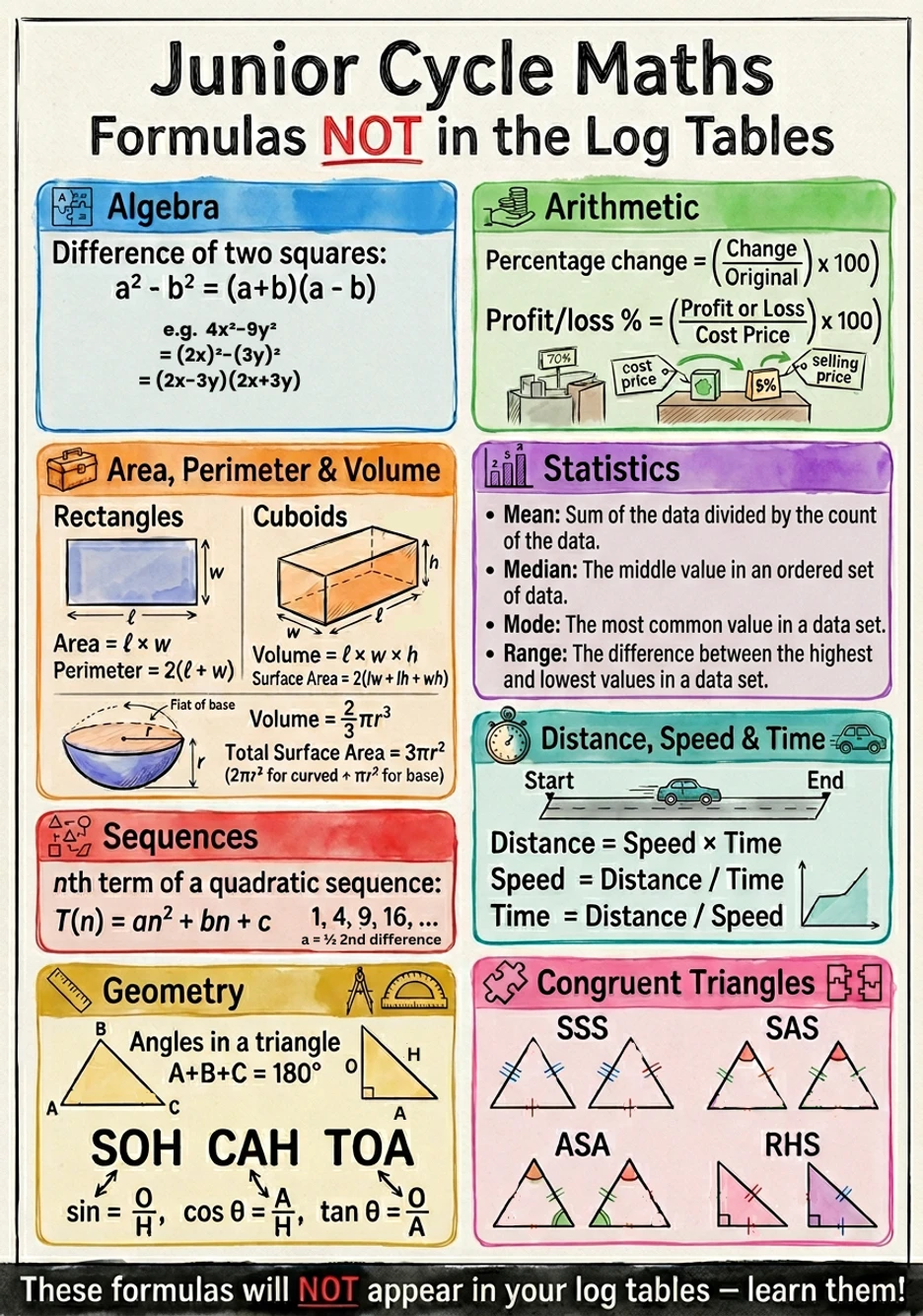
Your log tables are a lifeline in the exam — but they don’t contain everything. Some formulas you’re expected to know by heart. This post covers every formula that will NOT appear in your log tables, with worked examples and the mistakes students make most often.
Algebra
Difference of Two Squares
a² − b² = (a + b)(a − b)
This factorisation appears constantly in algebra and simplification questions.
Example: Factorise x² − 25
x² − 25 = x² − 5² = (x + 5)(x − 5)
Watch out! This only works when you’re subtracting two perfect squares. It does not work for a² + b² — that cannot be factorised.
Arithmetic
Percentage Change
Percentage change = (change ÷ original) × 100
This formula covers both percentage increase and percentage decrease.
Example: A phone was €200 and is now €250. What is the percentage increase?
Change = 250 − 200 = 50
Percentage change = (50 ÷ 200) × 100 = 25%
Percentage Profit or Loss
Percentage profit (or loss) = (profit or loss ÷ cost price) × 100
Example: A shopkeeper buys an item for €40 and sells it for €52.
Profit = 52 − 40 = 12
Percentage profit = (12 ÷ 40) × 100 = 30%
Watch out! Always divide by the original value — not the new value. For profit/loss, divide by the cost price, not the selling price.
Area, Perimeter & Volume
These basic shape formulas are not in the log tables — you’re expected to know them.
| Formula | Expression |
|---|---|
| Area of a rectangle | length × width |
| Perimeter of a rectangle | 2(l + w) |
| Surface area of a cuboid | 2(lw + lh + wh) |
| Volume of a cuboid | l × w × h |
| Volume of a hemisphere | ⅔πr³ |
Example: Find the volume of a cuboid with length 5 cm, width 3 cm, and height 4 cm.
Volume = 5 × 3 × 4 = 60 cm³
Watch out! The volume of a hemisphere is half the volume of a sphere (⁴⁄₃πr³ ÷ 2 = ⅔πr³). The sphere formula is in the log tables, but the hemisphere version is not — you need to halve it yourself.
Statistics
These four definitions come up in nearly every statistics question.
| Measure | Definition |
|---|---|
| Mean | Sum of all values ÷ number of values |
| Median | Middle value when data is in order |
| Mode | Most frequently occurring value |
| Range | Highest value − lowest value |
Example: Find the mean, median, mode, and range of: 3, 5, 5, 7, 10
- Mean: (3 + 5 + 5 + 7 + 10) ÷ 5 = 30 ÷ 5 = 6
- Median: Middle value = 5 (the 3rd value in the ordered list)
- Mode: 5 (appears twice)
- Range: 10 − 3 = 7
Watch out! For the median, you must put the data in order first. If there’s an even number of values, the median is the average of the two middle values.
Sequences
Quadratic Sequences
T(n) = an² + bn + c
This is the general form for the nth term of a quadratic sequence — a sequence where the second differences are constant.
Example: Find the nth term of 2, 6, 12, 20, 30, …
First differences: 4, 6, 8, 10
Second differences: 2, 2, 2 → constant, so a = 2 ÷ 2 = 1
Using T(n) = an² + bn + c with a = 1:
- T(1) = 1 + b + c = 2
- T(2) = 4 + 2b + c = 6
Solving: b = 1, c = 0
T(n) = n² + n
Watch out! If the first differences are constant, the sequence is linear — use T(n) = an + b instead. Only use the quadratic formula when the second differences are constant.
Distance, Speed & Time
These three are rearrangements of the same formula:
| To find | Formula |
|---|---|
| Distance | Speed × Time |
| Speed | Distance ÷ Time |
| Time | Distance ÷ Speed |
Example: A car travels at 80 km/h for 2.5 hours. How far does it go?
Distance = 80 × 2.5 = 200 km
Watch out! Make sure your units match. If speed is in km/h, time must be in hours — not minutes. Convert before calculating.
Geometry
Angle Sum of a Triangle
Angles in a triangle add up to 180°.
Example: Two angles in a triangle are 65° and 50°. Find the third.
Third angle = 180 − 65 − 50 = 65°
SOH CAH TOA
The three trigonometric ratios for right-angled triangles:
| Ratio | Formula |
|---|---|
| Sin θ | Opposite ÷ Hypotenuse |
| Cos θ | Adjacent ÷ Hypotenuse |
| Tan θ | Opposite ÷ Adjacent |
Watch out! SOH CAH TOA only works in right-angled triangles. For non-right-angled triangles, you need the Sine Rule or Cosine Rule (which are in the log tables).
Congruent Triangles — 4 Conditions
Two triangles are congruent (identical in shape and size) if they satisfy any one of these four conditions:
| Condition | Meaning |
|---|---|
| SSS | Three sides equal |
| SAS | Two sides and the included angle equal |
| ASA | Two angles and the included side equal |
| RHS | Right angle, hypotenuse, and one other side equal |
Watch out! AAA is NOT a congruence condition — two triangles can have the same three angles but be different sizes (these are similar, not congruent). Also, for SAS and ASA the angle/side must be between the two known elements.
Study tip
Make a flashcard for each formula on this page and test yourself until you can write them all from memory. In the exam, you won’t have time to derive these — you need instant recall. A good trick: group them by topic (algebra, arithmetic, geometry) and learn them in batches rather than all at once.
This post is based on an AI-generated infographic from Boomanotes — turn any study notes into visual revision aids.