Understanding Income Tax — Junior Cycle Maths Applied Arithmetic
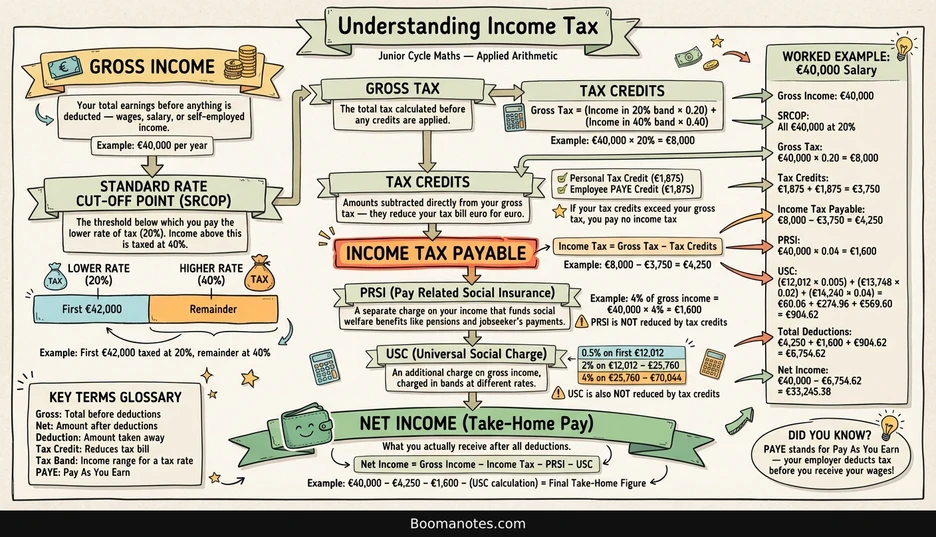
Income tax is one of the most practical topics in Junior Cycle maths. The calculation follows a clear sequence: start with gross income, calculate gross tax, subtract tax credits, then deduct PRSI and USC to arrive at your take-home pay. This post walks through each step.
Step 1 — Gross Income
Gross income is your total earnings before anything is deducted — wages, salary, or self-employed income.
Example: A person earns a salary of €40,000 per year. Their gross income is €40,000.
Step 2 — Tax Bands and the Standard Rate Cut-Off Point (SRCOP)
Income tax in Ireland is charged at two rates:
- 20% (standard rate) on income up to the Standard Rate Cut-Off Point
- 40% (higher rate) on any income above that threshold
The SRCOP varies depending on personal circumstances. For exam purposes, you’ll be given the cut-off point in the question.
Example: If the SRCOP is €42,000 and you earn €40,000, all your income falls in the 20% band. If you earned €50,000, the first €42,000 would be taxed at 20% and the remaining €8,000 at 40%.
Step 3 — Gross Tax
Gross tax is the total tax calculated before any credits are applied.
Gross Tax = (Income in 20% band × 0.20) + (Income in 40% band × 0.40)
Example (€40,000 salary, SRCOP of €42,000):
All €40,000 is within the 20% band:
€40,000 × 0.20 = €8,000 gross tax
Step 4 — Tax Credits
Tax credits are amounts subtracted directly from your gross tax — they reduce the tax bill euro for euro. Common tax credits include:
- Personal Tax Credit: €1,875
- Employee PAYE Credit: €1,875
If your tax credits exceed your gross tax, you pay no income tax (but you don’t get a refund of the difference).
Example: Total tax credits = €1,875 + €1,875 = €3,750
Step 5 — Income Tax Payable
Income Tax Payable = Gross Tax − Tax Credits
Example: €8,000 − €3,750 = €4,250 income tax payable
Step 6 — PRSI (Pay Related Social Insurance)
PRSI is a separate charge on your income that funds social welfare benefits like pensions and jobseeker’s payments. It is not reduced by tax credits.
The standard employee rate is 4% of gross income.
Example: €40,000 × 0.04 = €1,600
Step 7 — USC (Universal Social Charge)
USC is an additional charge on gross income. It is also not reduced by tax credits. USC is charged in bands:
| Band | Rate |
|---|---|
| First €12,012 | 0.5% |
| €12,012 to €25,760 | 2% |
| €25,760 to €70,044 | 4% |
Example (€40,000 salary):
- €12,012 × 0.005 = €60.06
- (€25,760 − €12,012) × 0.02 = €13,748 × 0.02 = €274.96
- (€40,000 − €25,760) × 0.04 = €14,240 × 0.04 = €569.60
Total USC = €60.06 + €274.96 + €569.60 = €904.62
Step 8 — Net Income (Take-Home Pay)
Net income is what you actually receive after all deductions.
Net Income = Gross Income − Income Tax − PRSI − USC
Example: €40,000 − €4,250 − €1,600 − €904.62 = €33,245.38
Full Worked Example Summary
| Step | Calculation | Amount |
|---|---|---|
| Gross Income | Salary | €40,000 |
| Gross Tax | €40,000 × 20% | €8,000 |
| Tax Credits | €1,875 + €1,875 | −€3,750 |
| Income Tax | €8,000 − €3,750 | €4,250 |
| PRSI | €40,000 × 4% | €1,600 |
| USC | Banded calculation | €904.62 |
| Total Deductions | €4,250 + €1,600 + €904.62 | €6,754.62 |
| Net Income | €40,000 − €6,754.62 | €33,245.38 |
Key Terms Glossary
- Gross — Total before deductions
- Net — Amount after deductions
- Deduction — Amount taken away
- Tax Credit — Reduces your tax bill directly
- Tax Band — Income range for a tax rate
- PAYE — Pay As You Earn (your employer deducts tax from your wages before you receive them)
Practice Questions
- A person earns €35,000 per year. The SRCOP is €42,000. Calculate their gross tax.
- Using the same salary, subtract tax credits of €3,750 to find the income tax payable.
- Calculate the PRSI at 4% on a salary of €50,000.
- A person earns €30,000. Calculate their total USC using the bands above.
- Putting it all together: find the net income for a salary of €45,000 with an SRCOP of €42,000, tax credits of €3,750, PRSI at 4%, and USC as per the bands above.
This post is based on an AI-generated infographic from Boomanotes — turn any study notes into visual revision aids.