Limitations of Statistics — Sources of Errors & Bias
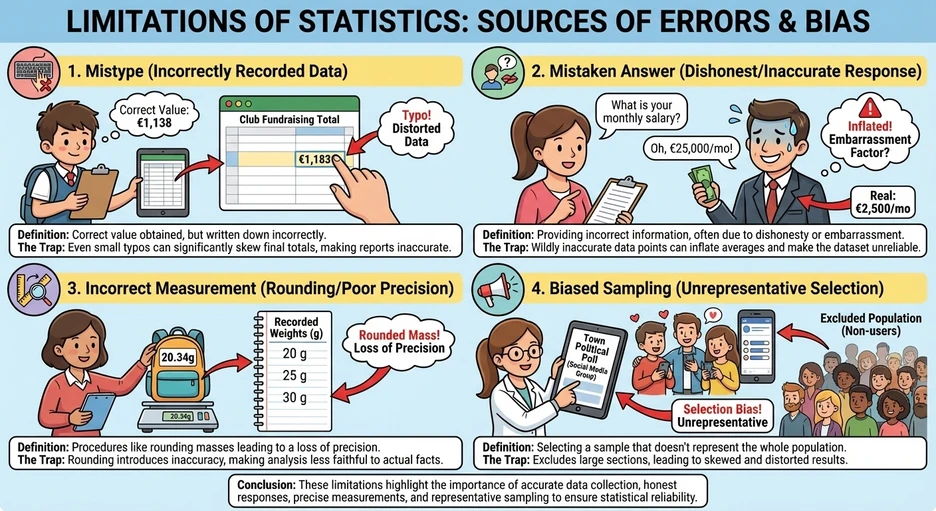
Statistics is a powerful tool, but it’s only as good as the data behind it. For your Junior Cycle maths exam, you need to know the four main sources of error and bias that can make statistical results unreliable.
1. Mistype (Incorrectly Recorded Data)
Definition: The correct value is obtained, but written down incorrectly.
For example, a club fundraising total of €1,138 gets recorded as €1,183 because of a simple typo.
The trap: Even small typos can significantly skew final totals, making reports inaccurate. One wrong digit can make specific calculations or analyses based on that data point inaccurate, potentially affecting the reliability of reports.
2. Mistaken Answer (Dishonest/Inaccurate Response)
Definition: Providing incorrect information, often due to dishonesty or embarrassment.
Imagine a survey asking “What is your monthly salary?” — someone earning €2,500/month might claim €25,000/month due to an embarrassment factor or simple exaggeration.
The trap: Wildly inaccurate data points can inflate averages and make the entire dataset unreliable. This is especially common with sensitive questions about income, age, or habits.
3. Incorrect Measurement (Rounding/Poor Precision)
Definition: Procedures like rounding masses or measurements lead to a loss of precision.
A scale reads 20.34g, but the recorded weight is rounded to 20g — that’s a loss of precision that adds up across many measurements.
The trap: Rounding introduces inaccuracy, making analysis less faithful to actual facts. The more you round, the less reliable your conclusions become.
4. Biased Sampling (Unrepresentative Selection)
Definition: Selecting a sample that doesn’t represent the whole population.
Running a political poll only on social media users excludes non-users entirely — creating selection bias that makes results unrepresentative.
The trap: Excludes large sections of the population, leading to skewed and distorted results. Your conclusions only apply to the group you actually sampled.
Key takeaway
These four limitations highlight the importance of:
- Accurate data collection — double-check entries to avoid typos
- Honest responses — use anonymous surveys for sensitive questions
- Precise measurements — record exact values, not rounded ones
- Representative sampling — ensure your sample reflects the whole population
Understanding these errors is essential for the statistics questions on your Junior Cycle exam. When you spot a source of bias in a question, name it clearly and explain why it makes the results unreliable.
This post is based on an AI-generated infographic from Boomanotes — turn any study notes into visual revision aids.