Number & Algebra Definitions — Key Concepts for Junior Cycle Maths
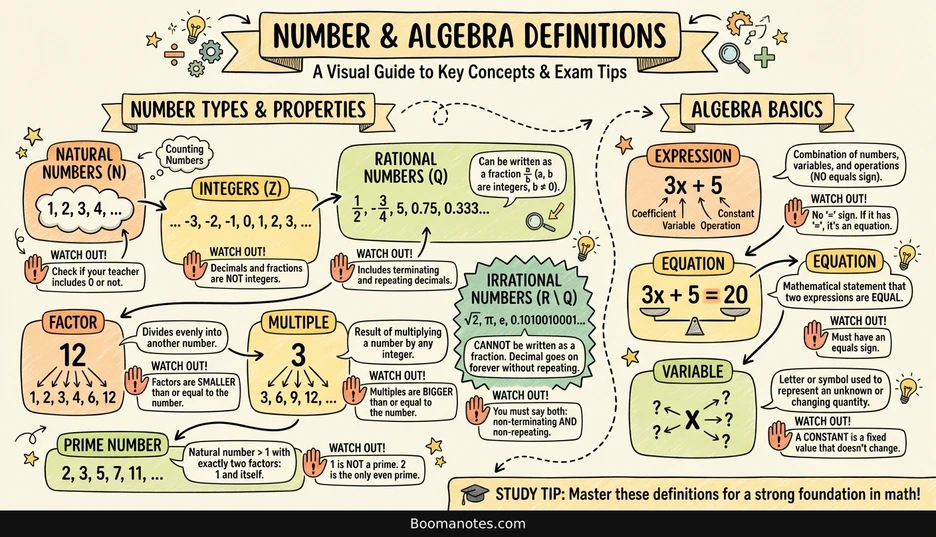
Number and algebra form the foundation of Junior Cycle maths. This post covers all the key definitions you need to know — from number types and properties to the building blocks of algebra.
Number Types & Properties
Natural Numbers (ℕ)
The counting numbers: 1, 2, 3, 4, …
**Watch out! 0 is not a natural number.
Integers (ℤ)
All whole numbers, positive and negative: … −3, −2, −1, 0, 1, 2, 3, …
Watch out! Decimals and fractions are not integers.
Rational Numbers (ℚ)
Any number that can be written as a fraction a/b where a and b are integers and b ≠ 0:
½, ⅔, 5, 0.75, 0.333…
Watch out! This includes terminating and repeating decimals. The number 5 is rational because it can be written as 5/1.
Irrational Numbers (ℝ \ ℚ)
Numbers that cannot be written as a fraction. Their decimal expansion goes on forever without repeating:
√2, π, e, 0.30100100010…
Watch out! You must say both: non-terminating AND non-repeating. If the decimal repeats, it’s rational, not irrational.
Number Properties
Factor
A number that divides evenly into another number.
Example: The factors of 12 are 1, 2, 3, 4, 6, 12
Watch out! Factors are smaller than or equal to the number.
Multiple
The result of multiplying a number by any integer.
Example: The multiples of 3 are 3, 6, 9, 12, …
Watch out! Multiples are bigger than or equal to the number.
Prime Number
A natural number greater than 1 with exactly two factors: 1 and itself.
2, 3, 5, 7, 11, …
Watch out! 1 is NOT a prime — it only has one factor. Also, 2 is the only even prime.
Algebra Basics
Expression
A combination of numbers, variables, and operations with no equals sign.
Example: 3x + 5
The parts: 3 is the coefficient, x is the variable, 5 is the constant, and + is the operation.
Watch out! If it has ”=”, it’s an equation, not an expression.
Equation
A mathematical statement that two expressions are equal.
Example: 3x + 5 = 20
Watch out! Must have an equals sign. An equation can be solved; an expression cannot.
Variable
A letter or symbol used to represent an unknown or changing quantity.
Example: x in the expression 3x + 5
Constant
A fixed value that doesn’t change.
Example: 5 in the expression 3x + 5
Watch out! Constants can be any number — they’re the terms with no variable attached.
Study tip
Master these definitions for a strong foundation in maths! On the exam, use the correct terminology — saying “a number that divides evenly” is good, but saying “a factor is a number that divides evenly into another number” is better.
This post is based on an AI-generated infographic from Boomanotes — turn any study notes into visual revision aids.