Volume of Prisms — How to Find the Volume of ANY Prism
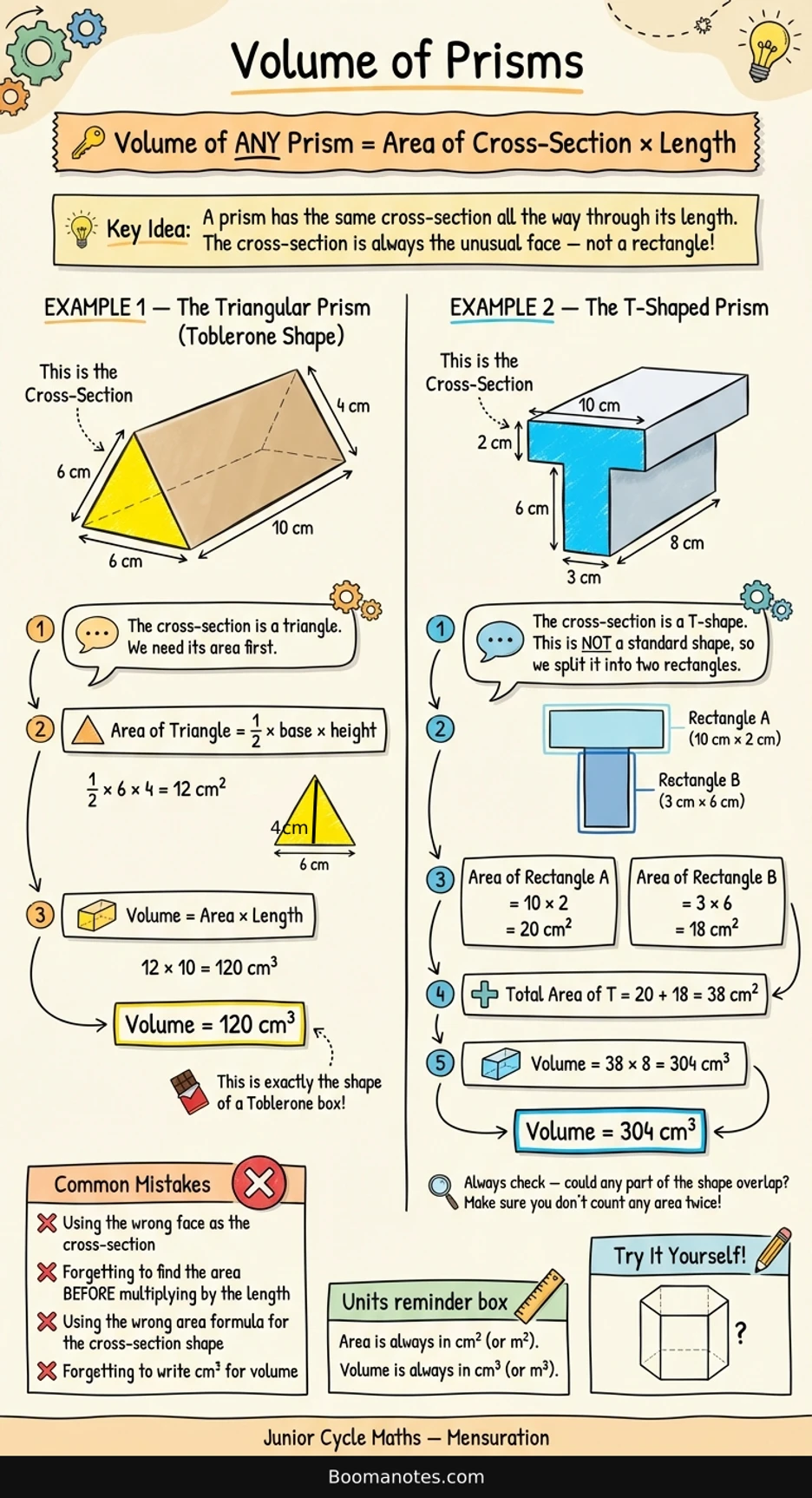
There’s one formula that works for every prism, no matter how unusual the shape:
Volume of ANY Prism = Area of Cross-Section × Length
The key is identifying the cross-section — the face that repeats all the way through the prism. The cross-section is the face that is uniform throughout the length of the prism. It can be any polygon, including a rectangle.
What Is a Prism?
A prism is a 3D shape that has the same cross-section all the way through its length. Think of it like a cookie cutter pushed through clay — the shape stays the same from front to back.
Common examples include triangular prisms (Toblerone shape), hexagonal prisms, and L-shaped or T-shaped prisms.
Example 1 — The Triangular Prism
A triangular prism has a triangle as its cross-section. The triangle is the face that repeats at both ends.
Given: base = 4 cm, height = 6 cm, length = 10 cm
Step 1 — Find the area of the cross-section (triangle):
Area of Triangle = ½ × b × h = ½ × 4 × 6 = 12 cm²
Step 2 — Multiply by the length:
Volume = Area × Length = 12 × 10 = 120 cm³
Watch out! Don’t forget the ÷ 2 when finding the area of a triangle. A very common mistake is to calculate base × height and forget to halve it — that would give you 240 cm³ instead of the correct 120 cm³.
Example 2 — The T-Shaped Prism
When the cross-section is a composite shape (like a T, L, or plus sign), split it into rectangles first.
Step 1 — Split the T into 2 rectangles:
The T-shape can be split into a horizontal top bar and a vertical stem.
- Area of Rectangle 1 (top bar) = l × w = 10 × 2 = 20 cm²
- Area of Rectangle 2 (stem) = l × w = 3 × 6 = 18 cm²
Step 2 — Find the total area:
Total Area of T = 20 + 18 = 38 cm²
Step 3 — Multiply by the length:
Volume = Area × Length = 38 × 8 = 304 cm³
Watch out! Make sure you find the total area of the full cross-section before multiplying by the length. A common error is to find the area of just one rectangle and multiply — that gives you only part of the volume.
The Method — Step by Step
For any prism question, follow these three steps:
- Identify the cross-section — the unusual face that repeats through the shape (not a rectangle)
- Calculate the area of that cross-section (split into simpler shapes if needed)
- Multiply by the length — the distance the cross-section extends through
That’s it. This works for triangular, pentagonal, L-shaped, T-shaped, or any other prism.
Common Mistakes
| Mistake | Why it’s wrong |
|---|---|
| Using the rectangular face as the cross-section | The cross-section is always the unusual face — the one that isn’t a rectangle |
| Forgetting ÷ 2 for triangles | Area of a triangle = ½ × b × h, not b × h |
| Only calculating part of a composite shape | For T-shapes, L-shapes, etc., you must find the total area of the full cross-section |
| Writing cm² instead of cm³ | Volume is always in cubic units (cm³, m³) because it measures 3D space |
Units Reminder
- Area is measured in squared units → cm², m²
- Volume is measured in cubed units → cm³, m³
Volume is cubed because you’re multiplying three dimensions together (the two dimensions of the cross-section area, plus the length).
Practice Problem
A prism has an L-shaped cross-section. The L is made up of two rectangles: one measuring 6 cm × 2 cm, and the other measuring 2 cm × 4 cm. The prism is 8 cm long.
Find the volume of the prism.
Hint: Find the total area of the L-shape first, then multiply by the length.
Study Tip
When you see a 3D shape in the exam, always ask yourself: “What face repeats through the shape?” That’s your cross-section. Once you find it, the rest is just area × length. Practise identifying cross-sections on different shapes until it becomes automatic — it’s the single most important skill for prism questions.
This post is based on an AI-generated infographic from Boomanotes — turn any study notes into visual revision aids.