Set Notation — A Visual Guide for Junior Cycle Maths
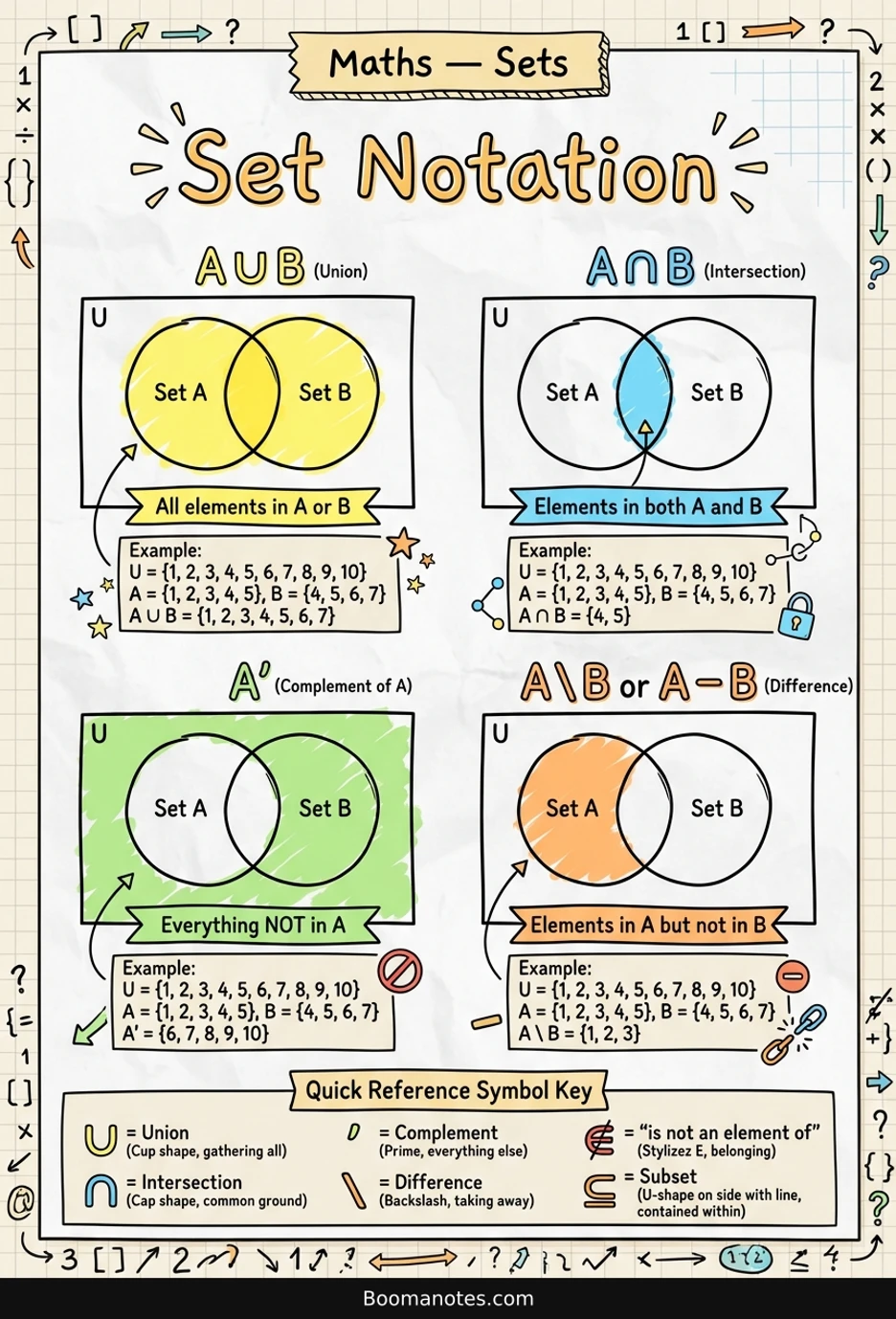
Sets are collections of elements, and set notation is the language we use to describe how those collections relate to each other. Once you learn the four main operations — union, intersection, complement, and difference — you can handle any sets question on the Junior Cycle exam.
The Four Operations
Throughout these examples we’ll use:
- U = {1, 2, 3, 4, 5, 6, 7, 8, 9, 10} (the universal set)
- A = {1, 2, 3, 4, 5}
- B = {4, 5, 6, 7}
A∪B — Union
“All elements in A or B (or both).”
Union combines everything from both sets into one. If an element is in either set, it’s in the union. Duplicates are only listed once.
Example: A∪B = {1, 2, 3, 4, 5, 6, 7}
On a Venn diagram, the entire shaded area of both circles represents the union.
Watch out! Union means “or”, not “and”. Students often confuse union with intersection. Think of ∪ as a cup that holds everything.
A∩B — Intersection
“Elements in both A and B.”
Intersection is only the elements that appear in both sets — the overlap.
Example: A∩B = {4, 5}
On a Venn diagram, only the overlapping region in the middle is shaded.
Watch out! If two sets have nothing in common, the intersection is the empty set (written ∅ or {}). Don’t write “0” — the empty set is a set with no elements, not the number zero.
A’ — Complement
“Everything NOT in A.”
The complement of A is every element in the universal set U that is not in A. You need to know U to find the complement.
Example: A’ = {6, 7, 8, 9, 10}
On a Venn diagram, everything outside the circle for A is shaded.
Watch out! The complement depends entirely on the universal set. If U changes, A’ changes too — even if A stays the same. Always check what U is before finding a complement.
A\B or A − B — Difference
“Elements in A but not in B.”
The difference removes from A anything that also appears in B. Only the part of A that doesn’t overlap with B remains.
Example: A\B = {1, 2, 3}
On a Venn diagram, only the part of circle A that doesn’t overlap with circle B is shaded.
Watch out! Order matters. A\B is not the same as B\A. In this example, B\A = {6, 7} — a completely different set.
Quick Reference Symbol Key
| Symbol | Name | Meaning |
|---|---|---|
| ∪ | Union | All elements in either set |
| ∩ | Intersection | Only elements in both sets |
| ’ | Complement | Everything not in the set |
| \ or − | Difference | Elements in one set but not the other |
Combining Operations
Exam questions often combine these operations. Work from the inside out, just like brackets in algebra.
Example: Find (A∪B)’ where U = {1, 2, 3, 4, 5, 6, 7, 8, 9, 10}, A = {1, 2, 3, 4, 5}, B = {4, 5, 6, 7}.
Step 1 — Find A∪B = {1, 2, 3, 4, 5, 6, 7}
Step 2 — Find the complement: (A∪B)’ = {8, 9, 10}
Example: Find A’∩B.
Step 1 — Find A’ = {6, 7, 8, 9, 10}
Step 2 — Find A’∩B = {6, 7}
Notice this is the same as B\A — the elements in B that aren’t in A.
Practice Questions
Using U = {1, 2, 3, 4, 5, 6, 7, 8, 9, 10}, A = {2, 4, 6, 8}, B = {1, 2, 3, 4}:
- Find A∪B.
- Find A∩B.
- Find A’.
- Find A\B.
- Find (A∩B)’.
This post is based on an AI-generated infographic from Boomanotes — turn any study notes into visual revision aids.