Junior Cycle Maths Theorems Part 1 — Theorems 1 to 9 Explained
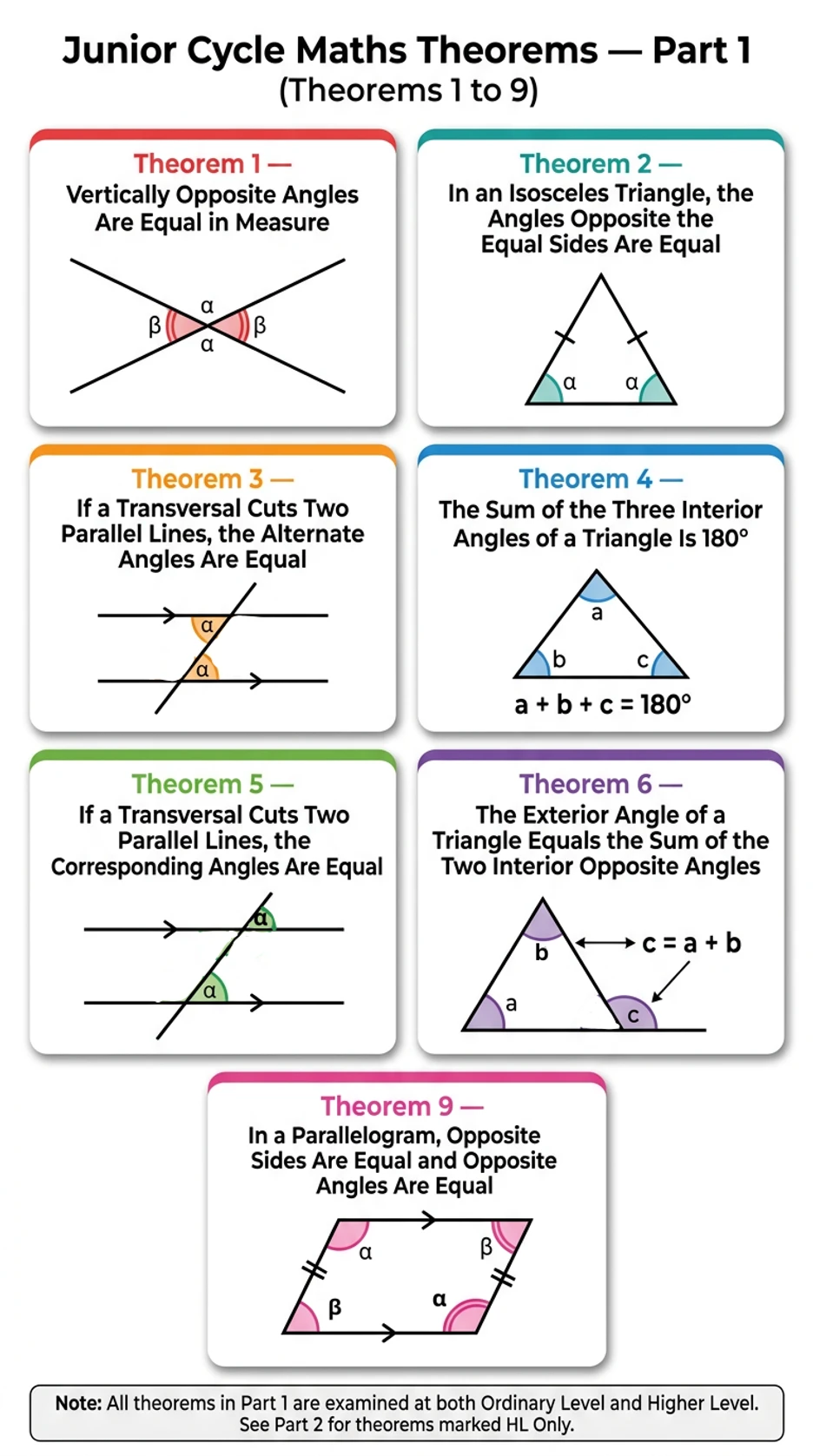
Theorems are one of those topics that students either love or dread. They look intimidating at first, but each one describes something that is visually obvious once you draw it out. This post walks through Theorems 1 to 9 from the Junior Cycle maths course — all of which appear at both Ordinary and Higher Level.
Theorem 1 — Vertically Opposite Angles Are Equal
When two straight lines cross, they form two pairs of opposite angles. These are called vertically opposite angles, and they are always equal.
Why it makes sense: Imagine two straight lines crossing like an X. Each angle and the one directly across from it are the same, because they’re both formed by the same two lines opening the same amount.
Exam tip: Questions often ask you to find a missing angle at an intersection. If two lines cross and one angle is 65°, the angle directly opposite is also 65°. The adjacent angles are each 115° (since angles on a straight line add to 180°).
Theorem 2 — Isosceles Triangle: Base Angles Are Equal
In an isosceles triangle, two sides are equal in length. The angles opposite those equal sides are also equal.
Why it makes sense: The two equal sides are mirror images of each other, so the angles they face must also be mirror images — meaning equal.
Exam tip: If you’re told a triangle is isosceles, immediately mark the two base angles as equal. This often unlocks the rest of the question, especially when combined with Theorem 4 (angles in a triangle sum to 180°).
Theorem 3 — Alternate Angles Are Equal (Parallel Lines)
When a line (called a transversal) cuts across two parallel lines, the alternate angles formed are equal. Alternate angles are on opposite sides of the transversal, between the two parallel lines — they form a Z-shape.
Why it makes sense: Because the lines are parallel, the transversal hits them at exactly the same angle. The Z-shape makes it easy to spot.
Exam tip: Look for the Z-shape in diagrams. Examiners often draw parallel lines with arrows on them (→→) to indicate they are parallel.
Theorem 4 — Angles in a Triangle Sum to 180°
The three interior angles of any triangle always add up to 180°.
a + b + c = 180°
Why it makes sense: If you tear the three corners off a triangle and place them side by side, they always form a straight line — which is 180°.
Exam tip: This is probably the most used theorem in geometry. Any time you have a triangle and two of the angles are known, subtract from 180° to find the third. Watch out for isosceles triangles where two angles are the same — you might only need one equation.
Theorem 5 — Corresponding Angles Are Equal (Parallel Lines)
When a transversal cuts two parallel lines, the corresponding angles are equal. Corresponding angles are on the same side of the transversal — one is between the parallel lines and one is outside. They form an F-shape.
Why it makes sense: The parallel lines are identical in direction, so the transversal hits each one at the same angle. The F-shape is the visual cue.
Exam tip: Alternate angles (Z-shape, Theorem 3) and corresponding angles (F-shape, Theorem 5) both come from parallel lines. Learn both shapes so you can spot which one applies in a diagram.
Theorem 6 — Exterior Angle of a Triangle
The exterior angle of a triangle equals the sum of the two interior opposite angles.
c = a + b
Where c is the exterior angle and a, b are the two interior angles not next to it.
Why it makes sense: The three angles of the triangle add to 180°. The exterior angle and the interior angle beside it also add to 180° (angles on a straight line). So the exterior angle must equal the sum of the other two interior angles.
Exam tip: This saves you a step. Instead of finding the third interior angle first, you can jump straight to the exterior angle by adding the two opposite interior angles. Look for the angle formed when one side of a triangle is extended beyond a vertex.
Theorem 9 — Opposite Sides and Angles of a Parallelogram Are Equal
In a parallelogram, opposite sides are equal in length and opposite angles are equal in measure.
Why it makes sense: A parallelogram has two pairs of parallel sides. By Theorems 3 and 5, the parallel sides force the angles to be equal in predictable ways.
Exam tip: If a question gives you a parallelogram, you can immediately state that opposite sides are equal and opposite angles are equal — without needing to prove it. This gives you free information to work with.
Exam Strategy
- Draw the diagram yourself — even if one is given, re-drawing it helps you see the angles and relationships more clearly.
- Label every angle you know before trying to find unknown ones.
- State the theorem when you use it. Examiners award marks for correct theorem references, not just correct numbers.
- Learn the shapes — Z for alternate, F for corresponding, X for vertically opposite. These visual shortcuts work faster than memorising the words.
Theorems You Must Be Able to Prove (Higher Level Only)
Formal proofs are examinable at Higher Level only. The theorems HL students are expected to prove are:
- Theorem 4 — The angles in any triangle sum to 180°
- Theorem 6 — Each exterior angle of a triangle equals the sum of the two interior opposite angles
- Theorem 9 — In a parallelogram, opposite sides are equal and opposite angles are equal
- Theorem 14 — The Theorem of Pythagoras
- Theorem 19 — The angle at the centre of a circle is twice the angle at the circumference
Three of these five (Theorems 4, 6, and 9) are covered in this post. See Part 2 for Theorems 14 and 19.
Key rule: At Ordinary Level, students only need to be able to use the theorems to solve problems. At Higher Level, students must be able to both use them and formally prove the five listed above.
Practice Questions
- Two lines intersect. One of the angles formed is 72°. Find all four angles at the intersection.
- An isosceles triangle has a base angle of 50°. Find the third angle.
- A triangle has angles of 45° and 80°. Find the third interior angle and the exterior angle at that vertex.
- A parallelogram has one angle of 110°. Find all four angles.
This post is based on an AI-generated infographic from Boomanotes — turn any study notes into visual revision aids.