Junior Cycle Maths Theorems Part 2 — Theorems 10 to 19 Explained
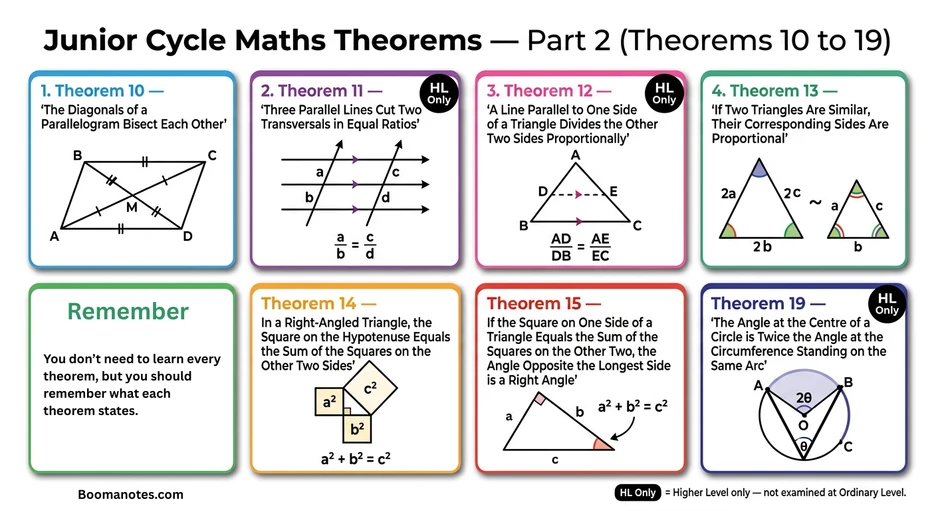
This is Part 2 of our Junior Cycle Maths theorems guide. Part 1 covered Theorems 1 to 9 (angles, parallel lines, and parallelograms). This post covers Theorems 10 to 19, which deal with parallelogram diagonals, proportional division, similar triangles, Pythagoras, and the circle theorem. Some of these are Higher Level only — these are marked with (HL).
Theorem 10 — The Diagonals of a Parallelogram Bisect Each Other
The two diagonals of a parallelogram cross at their midpoints — meaning each diagonal cuts the other exactly in half.
Why it makes sense: A parallelogram is symmetrical about its centre. The point where the diagonals meet is that centre, so it must be the midpoint of both diagonals.
Exam tip: If a question gives you a parallelogram with diagonals drawn, you immediately know that each half-diagonal is equal. This is useful for finding unknown lengths or proving that a quadrilateral is a parallelogram.
Theorem 11 — Three Parallel Lines Cut Transversals in Equal Ratios (HL)
If three parallel lines cut across two transversals (straight lines crossing all three), the segments on one transversal are in the same ratio as the segments on the other.
Why it makes sense: The parallel lines are evenly spaced in terms of direction, so they divide any line crossing them proportionally — not necessarily into equal parts, but in the same ratio on both transversals.
Exam tip: This theorem is about ratios, not equal lengths. If the first transversal is divided in the ratio 2:3, then the second transversal is also divided in the ratio 2:3 — but the actual lengths on the two transversals can be different.
Theorem 12 — A Line Parallel to One Side of a Triangle Divides the Other Two Sides Proportionally (HL)
If a line is drawn parallel to one side of a triangle and it cuts the other two sides, it divides those two sides in the same ratio.
Why it makes sense: This is essentially Theorem 11 applied inside a triangle. The parallel line and the side it’s parallel to act like two of the three parallel lines, and the two sides of the triangle act as the transversals.
Exam tip: This theorem often appears in questions where a line cuts two sides of a triangle and you need to prove it’s parallel to the third side, or where you need to find a missing length. Set up the ratios and solve.
Theorem 13 — Similar Triangles Have Proportional Sides
If two triangles are similar (same shape, possibly different size), their corresponding sides are proportional.
Why it makes sense: Similar triangles have the same angles. Since the angles are the same, the triangles are just scaled versions of each other — so every side is multiplied by the same scale factor.
Exam tip: To use this theorem, first identify which sides correspond (match the sides opposite equal angles). Then set up a proportion. For example, if the scale factor is 2, every side in the larger triangle is twice the matching side in the smaller one.
Theorem 14 — The Theorem of Pythagoras
In a right-angled triangle, the square of the hypotenuse (the longest side, opposite the right angle) equals the sum of the squares of the other two sides.
a² + b² = c²
Where c is the hypotenuse.
Why it makes sense: If you draw a square on each side of a right-angled triangle, the area of the largest square exactly equals the combined areas of the other two.
Exam tip: Pythagoras works both ways — use it to find a missing side when you know the other two. Make sure c is always the hypotenuse. A common mistake is putting the wrong side as c. The hypotenuse is always opposite the right angle and is always the longest side.
Theorem 15 — Converse of Pythagoras
If the square on one side of a triangle equals the sum of the squares on the other two sides, then the angle opposite that side is a right angle.
Why it makes sense: This is Theorem 14 in reverse. If the numbers satisfy a² + b² = c², then the triangle must contain a 90° angle.
Exam tip: Use this to prove a triangle is right-angled. Calculate a² + b² and c² separately. If they’re equal, it’s a right angle. If not, it isn’t. This is cleaner than trying to measure the angle.
Theorem 19 — The Angle at the Centre Is Twice the Angle at the Circumference
The angle at the centre of a circle standing on the same arc is twice the angle at the circumference standing on the same arc.
Why it makes sense: The vertex at the centre is closer to the arc than a vertex on the circumference, so it “sees” the arc at a wider angle — exactly twice as wide.
Exam tip: Look for two angles that stand on (subtend) the same arc. If one vertex is at the centre and the other is on the circumference, the centre angle is double. This also means if the centre angle is 120°, the circumference angle is 60°.
Theorems You Must Be Able to Prove (Higher Level Only)
Formal proofs are examinable at Higher Level only. The theorems HL students are expected to prove are:
- Theorem 4 — The angles in any triangle sum to 180°
- Theorem 6 — Each exterior angle of a triangle equals the sum of the two interior opposite angles
- Theorem 9 — In a parallelogram, opposite sides are equal and opposite angles are equal
- Theorem 14 — The Theorem of Pythagoras
- Theorem 19 — The angle at the centre of a circle is twice the angle at the circumference
Two of these five (Theorems 14 and 19) are covered in this post. See Part 1 for Theorems 4, 6, and 9.
Key rule: At Ordinary Level, students only need to be able to use the theorems to solve problems. At Higher Level, students must be able to both use them and formally prove the five listed above.
You Don’t Need to Memorise Every Proof
As the infographic reminds us: you don’t need to learn every theorem’s proof, but you should know what each theorem states. Being able to recognise which theorem applies in a question is half the battle. The proofs are only required for the five theorems listed above, and only at Higher Level.
Practice Questions
- A parallelogram has diagonals of length 10 cm and 14 cm. What is the length of each half-diagonal?
- A right-angled triangle has sides of 5 cm and 12 cm. Find the hypotenuse.
- A triangle has sides of 6 cm, 8 cm, and 10 cm. Prove it is right-angled.
- An angle at the centre of a circle is 140°. What is the angle at the circumference standing on the same arc?
This post is based on an AI-generated infographic from Boomanotes — turn any study notes into visual revision aids.